
Accenture: SCM Planning Architect Interview Guide
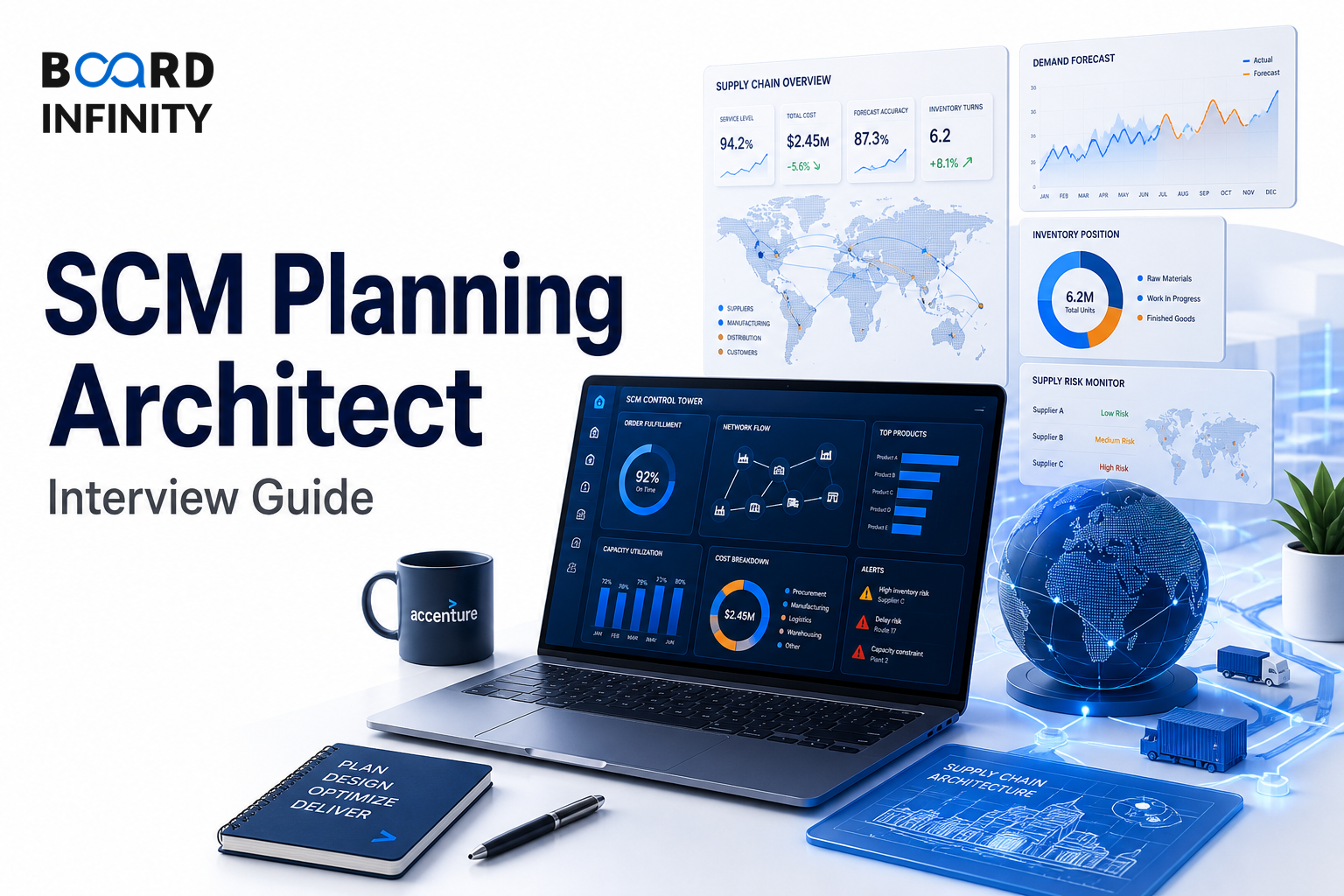
The Business, Industry & Functional Architect - Supply Chain Management (SCM) Planning role at Accenture connects business planning problems with enterprise platform solutions. The role matters because better demand, supply, inventory, and production planning decisions can reduce delays, improve service levels, and help leaders act on reliable data.
This guide is built for campus and early-career candidates preparing for Accenture interviews in SCM Planning, business analysis, and functional consulting. It covers the role, required skills, daily work, competencies, interview process, role-specific questions, focus topics, a four-week plan, and practical next steps.
1. About the Business, Industry & Functional Architect - SCM Planning Role
This role turns supply chain planning needs into workable platform designs. You may study how a client forecasts demand, plans inventory, allocates supply, or tracks exceptions, then convert those needs into process maps, functional designs, reports, and test scenarios that delivery teams can build and users can adopt.
Day-to-day, the role works with client business users, Accenture delivery teams, subject matter experts, data teams, testers, and change teams. If you want a close comparison within Accenture, the Team Lead Business, Industry and Functional Architect interview guide is a useful next reference for similar functional consulting expectations.
2. Required Skills and Qualifications
Eligibility Signals Stated for the Role
Skills Overview
3. Day-to-Day Responsibilities
A typical week combines client discussions, process analysis, design documentation, data checks, testing support, and adoption activities. The work is practical: you translate planning pain points into usable system behavior and keep business and technical teams aligned.
Capture Planning Needs
You speak with planners, supply chain managers, finance users, and operations teams to understand what decisions they need to make. Instead of only recording requests, you clarify the planning trigger, data source, approval path, reporting need, and expected business outcome.
Map Current Workflows
You document how planning happens today, including spreadsheets, manual approvals, system handoffs, and frequent exceptions. For example, you may map how a demand forecast moves from sales inputs to supply review and identify where delays or duplicate entries occur.
Design Future Flows
You convert the improved process into future-state business and data flows. This can include defining planning calendars, approval roles, exception rules, dashboard views, access levels, and handoffs between ERP, planning tools, and analytics systems.
Support Build Teams
You explain requirements to configuration, development, data, reporting, and testing teams. When trade-offs appear, such as whether to customize a report or use standard platform capability, you help compare business value, complexity, timeline, and long-term support impact.
Drive Testing Readiness
You prepare test cases for planning scenarios such as stock shortage, forecast revision, delayed supplier shipment, or demand spike. During User Acceptance Testing, you help users validate results, document defects clearly, and confirm whether fixes meet the original business need.
Enable Adoption
You support go-live by preparing training material, answering user questions, tracking adoption issues, and checking whether the new process delivers value. The goal is not only to launch a system, but to help planners trust it and use it consistently.
4. Key Competencies for Success
Strong candidates show that they can think like a consultant, a planner, and a delivery team member at the same time. Accenture interviews usually reward structured thinking, business clarity, collaboration, and the ability to turn ambiguity into practical next actions.
5. Interview Process at Accenture
Prepare for a mix of online screening, communication assessment, business discussion, functional problem solving, and managerial evaluation. For this role, interviewers are likely to test whether you can understand a supply chain planning problem, structure it clearly, communicate with clients, and work in an enterprise technology delivery setup.
Application Screening
Recruiters review whether your profile aligns with business analysis, SCM Planning, data handling, process design, communication, and tool exposure. Your resume should show relevant projects, internships, case competitions, operations coursework, analytics work, or ERP exposure in practical terms.
Aptitude and Communication Check
Campus processes commonly include quantitative reasoning, logical reasoning, verbal ability, and communication evaluation. For this role, clear business writing and structured explanations matter because the job involves requirements documents, process flows, meeting notes, and client-facing presentations.
Functional and Technical Discussion
A functional interviewer may test SCM Planning concepts, requirement gathering, process mapping, fit-gap analysis, SQL basics, dashboard thinking, UAT, and Agile delivery. Expect scenario questions such as how to handle demand variance, poor master data, user access conflicts, or conflicting client requirements.
Case or Scenario Round
You may be given a business problem and asked to structure the solution. A strong response defines the objective, lists assumptions, separates process and data issues, recommends a future workflow, identifies risks, and states how success will be measured after go-live.
Managerial and HR Discussion
The final discussion checks ownership, communication maturity, learning mindset, teamwork, relocation readiness, and fit with consulting delivery. Prepare crisp answers for why Accenture, why SCM Planning, how you handle ambiguity, and how you respond to feedback under deadline pressure.
6. Interview Questions
Use STAR for behavioral answers: Situation, Task, Action, Result. For role-specific and case questions, use a structured business consulting flow: clarify the objective, map the process, identify data needs, propose the solution, define tests, and state measurable impact.
Behavioral & Company-Fit Questions
Role-Specific SCM Planning & Functional Questions
Case-Based & Analytical Questions
7. Topics and Areas of Focus
Focus your preparation on the areas that connect supply chain planning, enterprise platforms, analytics, testing, and client communication. The strongest candidates can explain both the business reason and the implementation implication for each topic.
8. Preparation Plan
Role Basics
Understand Accenture, SCM Planning, and the functional architect role.
Core Skills
Practise process mapping, SQL, Excel, dashboards, and fit-gap analysis.
Interview Stories
Build STAR stories and practise functional scenario answers.
Mock Rounds
Run timed mock interviews and revise weak areas.
Pre-Interview Checklist
If you need additional SCM functional consulting examples outside Accenture, the SCM Functional Consultant Trainee Consultant interview guide can help you compare how similar planning and ERP-facing roles are assessed.
9. Career Growth & Next Roles
Growth in this track usually depends on how well you handle larger modules, client conversations, delivery ownership, and measurable transformation outcomes. Candidates who build both SCM domain depth and platform delivery judgment can move toward solution ownership, project leadership, or specialist architecture roles.
Business, Industry & Functional Architect
At the current stage, you own requirements, process flows, functional designs, test support, reporting needs, access design, and user adoption support for defined workstreams. To grow, prove that you can handle ambiguity, communicate with client users, and convert planning problems into build-ready deliverables.
Functional Workstream Lead
After building delivery credibility, you may own a planning sub-module such as demand planning, supply planning, reporting, or UAT. This stage requires better estimation, issue management, client workshop leadership, backlog prioritization, and the ability to guide junior analysts without losing detail.
Solution or Process Architect
At this level, you shape end-to-end solution direction across business process, data, platform, integration, reporting, controls, and adoption. You must prove that design decisions are scalable, supportable, and linked to business outcomes such as planning cycle time, service level, or inventory health.
Manager or Deep Specialist
Beyond solution ownership, the path can split into people management or deep specialization. A manager handles teams, client governance, delivery risk, and commercial priorities. A specialist builds deep expertise in planning platforms, advanced analytics, AI-enabled planning, or industry-specific supply chain transformation.
10. Conclusion
The most important preparation move is to stop answering like a student and start answering like a functional consultant. For every SCM Planning scenario, show the business objective, process flow, data dependency, system behavior, test approach, user impact, and success metric.
Before the interview, prepare one strong example each for requirement gathering, process mapping, data validation, UAT, and change adoption. Also revise Accenture campus selection expectations through the Accenture Campus Placement Guide if your process includes aptitude or communication screening.
