
Yamaha Motor India Group Careers Interview Guide
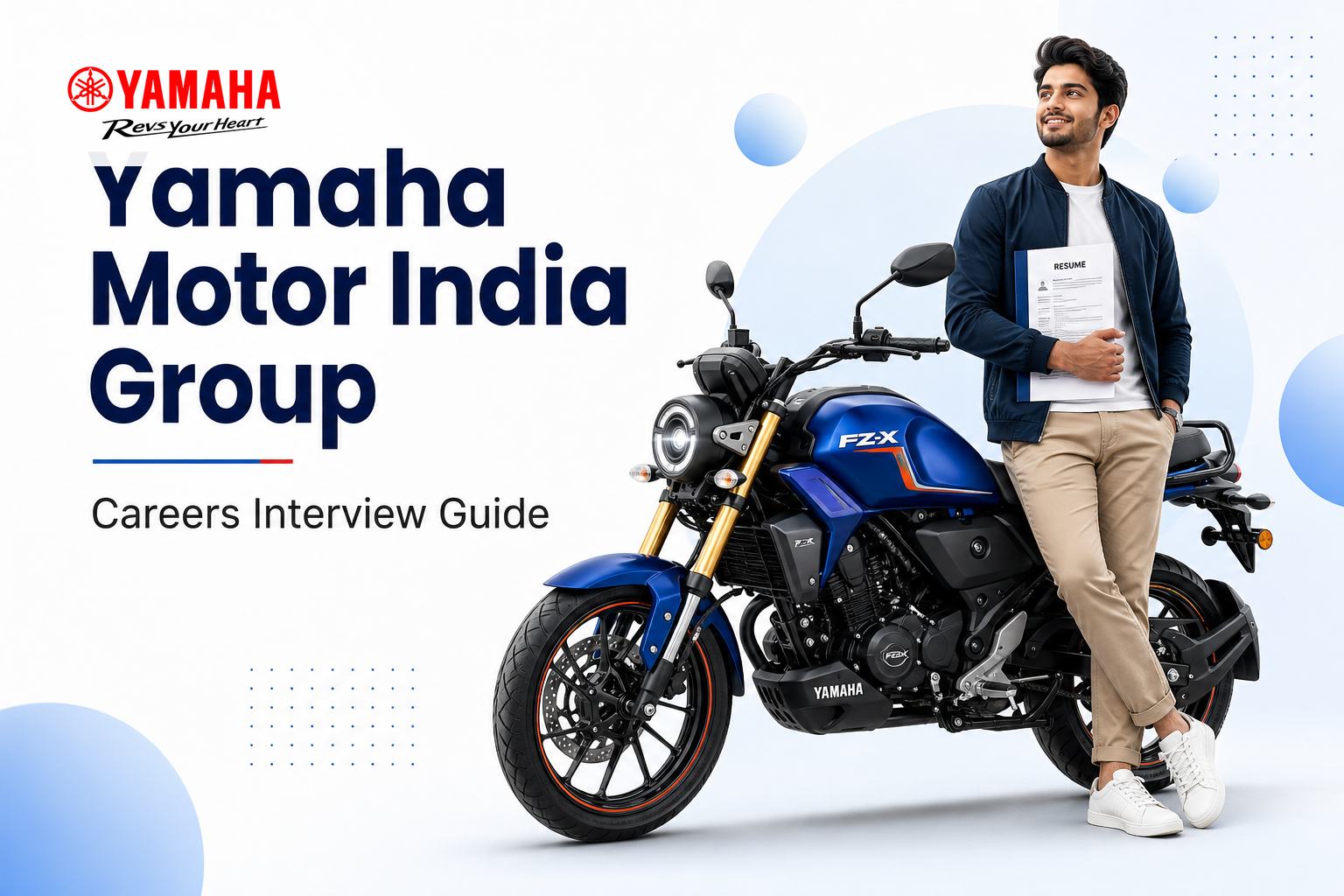
Yamaha Motor India Group is the Indian business ecosystem of Yamaha Motor for motorcycles, scooters, riding gear, after-sales support and the operations that connect factories, dealers, service workshops and customers. It sits in the automobile industry, with a strong focus on personal mobility, performance-led products and brand-led retail. For candidates, the company matters because it combines Japanese manufacturing discipline with Indian market execution. A role here can involve product positioning, dealer development, service quality, supply chain coordination, engineering support, customer experience or digital marketing. The group is useful to study because its work is not limited to selling vehicles; it also covers localisation, product planning, warranty support, spare parts, accessories and brand communities. Interviewers may expect candidates to understand how a premium mobility brand balances aspirational design, reliable service, regulatory requirements and practical affordability in a competitive Indian market.
This guide covers where Yamaha Motor India Group came from, who controls it today, and the products and services it is built around.
1. Company Overview
About Yamaha Motor India Group
Yamaha Motor India Group represents Yamaha Motor’s India operations across vehicle manufacturing, sales and marketing, research and development support, and after-sales activities. Yamaha’s official India profile describes its India journey as beginning with market entry and later moving into a Yamaha Motor-led subsidiary and group structure (Yamaha Motor India About Us).
That makes the company a useful case study for candidates applying to roles in sales, channel management, service operations, product marketing, manufacturing, quality, supply chain and engineering support. Candidates comparing automobile operating models can also read Board Infinity’s Tata Motors company overview to contrast a broad Indian automotive group with a focused motorcycle-and-scooter brand structure.
Company History
Candidates should read Yamaha’s India history as an operating-model story: the business moved from entry into India, to closer parent-company control, and then to a broader group structure covering manufacturing, sales, research and market operations. These shifts are interview-relevant because they explain why Yamaha India roles often sit at the intersection of brand, engineering discipline, dealer execution and customer service.
Yamaha Motor made its initial foray into India, marking the start of its long-term participation in the Indian motorcycle and scooter market (Yamaha Motor India history).
In August 2001, Yamaha’s India business became a subsidiary of Yamaha Motor Co., Ltd., Japan, tightening the connection between the Indian operation and Yamaha’s global parent company (Yamaha Motor India history).
Mitsui & Co. entered as a joint investor in India Yamaha Motor Pvt. Ltd., adding a strategic partnership layer to the India manufacturing and business structure (Yamaha Motor India history).
Yamaha Motor Research and Development India became part of the India ecosystem, strengthening local product, engineering and market support capability within the group structure (Yamaha Motor India profile).
Yamaha expanded its India manufacturing footprint with operations in the south, supporting a wider national supply and production base (Yamaha Motor India profile).
Yamaha Motor India Group’s structure increasingly separated specialised functions such as manufacturing, sales and marketing, and research support, giving candidates a clearer view of role-specific business units (Yamaha Motor India profile).
2. Mission, Vision & Values
Mission
"Kando* Creating Company: Offering new excitement and a more fulfilling life for people all over the world."
This is Yamaha Motor’s official corporate mission as published in its corporate philosophy (Yamaha Motor corporate philosophy). In an interview, connect it to customer delight, product feel, riding experience and service reliability rather than treating it as a slogan to memorise.
Vision
Yamaha Motor India presents Yamaha Motor’s corporate philosophy and brand promise rather than a separate India-specific vision line. Use the mission, brand slogan and action guidelines together to explain how your work would support excitement, trust and disciplined execution.
Core Values
Yamaha Motor publishes these as official action guidelines within its corporate philosophy, and they are the safest values to prepare against because the wording is the company’s own.
Prepare interview stories against this exact list: a fast decision, a stretch target, and a situation where you kept improving after the first result.
3. Products and Services
Yamaha Motor India Group’s offering is centred on motorcycles, scooters and the services that support ownership after purchase. Its official product catalogue includes performance motorcycles, street motorcycles and scooters for the Indian market (Yamaha Motor India products), making the company relevant for candidates in product, retail, service, operations, engineering, supply chain and customer experience roles.
- Motorcycles Yamaha’s motorcycle range covers performance and street-focused products such as the R15 family, MT series, FZ series and FZ-X, so candidates should understand positioning, customer segments, safety features, design appeal and dealer-level conversion.
- Scooters The scooter portfolio includes models such as Fascino, RayZR and Aerox, which makes the business relevant for roles involving urban mobility, commuter convenience, fuel-efficiency messaging, showroom comparison handling and after-sales retention.
- Authorised sales and dealer operations Yamaha sells through authorised retail channels where teams manage enquiries, test rides, finance coordination, exchange conversations, delivery experience and customer follow-up.
- After-sales service Service operations cover scheduled maintenance, inspections, repair support, warranty handling and workshop experience, all of which are important for candidates applying to service advisor, technical, operations or customer-care roles.
- Genuine parts and accessories The group supports ownership through genuine spare parts, riding accessories and vehicle accessories, which creates workstreams in inventory planning, counter sales, workshop coordination, quality assurance and customer education.
- Research, localisation and product support Yamaha’s India ecosystem includes research and development support for local market needs, so engineering and product candidates should be ready to discuss Indian riding conditions, feature expectations, cost discipline and regulatory compliance.
- Brand and riding community initiatives Yamaha’s premium positioning relies on experience-led marketing, rider engagement, digital campaigns and product storytelling, which makes the company relevant for candidates in marketing, CRM, content, events and customer loyalty roles.
4. Key Competitors of Yamaha Motor India Group
Yamaha Motor India Group competes in India’s two-wheeler market, where rivals fight across commuter motorcycles, scooters, premium bikes and lifestyle-led performance segments. Competition is not only about sales scale; it runs on product positioning, fuel efficiency, design appeal, pricing, financing, dealer reach, service quality and brand pull among young riders.
Hero MotoCorp
Competes on: commuter motorcycles, mileage-led value, wide retail access and after-sales confidence.
Position: Strong in practical, everyday mobility; Yamaha needs to differentiate through sportier design, ride feel and youth-oriented branding.
Honda Motorcycle & Scooter India
Competes on: scooters, commuter motorcycles, refinement, service trust and family-oriented brand appeal.
Position: A direct rival in scooters and accessible motorcycles; Yamaha can contrast itself through sharper styling and performance-led identity.
TVS Motor Company
Competes on: sporty commuter bikes, scooters, connected features, racing-linked branding and urban technology cues.
Position: Strong in feature-rich, youth-facing products; Yamaha overlaps with TVS where buyers compare styling, performance and perceived excitement.
Bajaj Auto
Competes on: performance commuters, street bikes, price-value balance, financing access and dealer coverage.
Position: Strong in value-performance positioning; Yamaha should be compared on brand premium, refinement and rider aspiration rather than price alone.
Suzuki Motorcycle India
Competes on: scooters, premium commuters, Japanese brand trust, retail experience and reliability perception.
Position: A close comparison set for buyers seeking a Japanese two-wheeler brand; Yamaha can stand out through sportier design language and riding character.
Royal Enfield
Competes on: premium upgrade budgets, lifestyle motorcycling, community appeal and emotionally driven ownership.
Position: Less direct in commuter segments but relevant when aspirational riders compare premium motorcycles and brand identity.
In an interview, structure competitive analysis by comparing Yamaha with two or three relevant rivals on segment, customer profile, pricing, distribution, service experience and brand positioning, rather than treating “who is bigger” as the complete answer.
5. Corporate Social Responsibility (CSR)
For Yamaha Motor India Group, CSR is naturally linked to safe mobility, responsible manufacturing and employability around the two-wheeler ecosystem, because the business touches riders, dealers, technicians, suppliers and local communities. As part of Yamaha Motor Co., Ltd., Japan's mobility group, India-facing CSR themes should be understood in the context of manufacturing discipline, customer safety and long-term social trust. Before naming any specific programme in an interview, verify the latest company communication so you do not cite an outdated campaign or local initiative.
Road Safety Awareness
A two-wheeler business can create real impact by promoting helmet use, defensive riding and safer behaviour among young riders and commuters.
Skill Development
Training themes can connect with mechanic skills, service quality, shop-floor discipline and employability for youth interested in mobility careers.
Environment & Resource Care
Manufacturing-linked CSR themes often include waste reduction, water awareness, energy discipline and greener habits around facilities and communities.
Education Support
Education-oriented work can support school readiness, technical curiosity, career exposure and better access to learning resources for nearby communities.
Health & Community Wellbeing
Community wellbeing themes can include basic health awareness, hygiene, local support activities and emergency-readiness initiatives around operating areas.
Responsible Mobility Culture
The brand can extend its social role by encouraging responsible ownership, disciplined servicing and respect for pedestrians, pillion riders and other road users.
6. Interview Process & Selection Rounds
Hiring at Yamaha Motor India Group usually follows a practical automotive-company pattern: application screening, recruiter or HR discussion, function-level assessment, managerial interviews and final offer checks. The exact route changes by function, seniority and location, so a plant operations candidate may be tested on safety and production discipline, while a sales, service, marketing, R&D or corporate candidate is assessed through role-specific business situations.
If you are comparing Indian automotive hiring patterns across manufacturers, the Tata Motors automotive company interview guide is a useful benchmark for how OEM-style roles can differ between manufacturing, sales, engineering and business functions.
Application Screening
Recruiters check education, experience, location fit and function relevance. Manufacturing profiles are screened for plant exposure and safety mindset, sales and service profiles for dealer or customer-facing experience, and R&D profiles for engineering depth.
Recruiter or HR Discussion
This round checks motivation, communication, salary expectations, joining timeline and basic understanding of Yamaha Motor India Group. Freshers are assessed for clarity and learning attitude, while experienced candidates are also asked about career moves and stability.
Functional Assessment
The company evaluates whether you can do the actual work. Plant roles may face questions on production, quality and 5S habits; sales roles may get dealer-performance situations; service roles may discuss complaint handling; engineering roles may be tested on design, testing or problem-solving basics.
Managerial Interview
A hiring manager tests judgement, ownership, stakeholder handling and ability to work in a structured Japanese-origin automotive culture. Senior candidates should expect deeper questions on targets, dealer economics, quality systems, team handling, vendor coordination or cross-functional execution.
Final HR, Documentation and Offer Discussion
The final stage usually confirms compensation, notice period, preferred location, background details and fit with company expectations. Candidates for plant and field roles should be especially clear about shift readiness, travel, relocation and territory responsibilities.
7. Common Interview Questions Across Roles
These are the questions any Yamaha Motor India Group candidate can face whatever the function, while role-specific technical questions belong in that role's own guide.
General & Company-Fit Questions
8. Required Skills & Tools
Required skills at Yamaha Motor India Group are not one flat list; each career route needs a different mix of customer, technical, analytical and execution skills, mapped below to the same routes used in Career Opportunities.
9. Career Opportunities at Yamaha Motor India Group
Careers at Yamaha Motor India Group are best understood as functional routes rather than one single ladder: factory, engineering, quality, sales, service, supply chain, and corporate roles each reward different evidence. For interview preparation, match your experience to the route closest to the job description and prepare examples around the decisions, stakeholders, performance measures, and promotion signal that route values.
Manufacturing & Production
This route covers roles such as Graduate Engineer Trainee, Production Engineer, Line Supervisor, Shift In-charge, Assistant Manager Production, and Production Manager across shop-floor execution, manpower planning, takt adherence, safety discipline, and output stability; the growth signal is consistently improving productivity, quality, safety, and delivery without creating rework or escalation.
Quality Assurance
This route includes Quality Engineer, Supplier Quality Engineer, Incoming Quality Inspector, Process Quality Engineer, Assistant Manager Quality, and Quality Manager roles focused on inspection systems, root-cause analysis, audit readiness, defect prevention, and corrective actions; the growth signal is reducing repeat defects through permanent process control rather than short-term sorting.
Research, Development & Engineering
This route is suited to Design Engineer, Development Engineer, Testing Engineer, Validation Engineer, CAD Engineer, Assistant Manager Engineering, and Project Engineer profiles working on product improvement, component validation, cost optimisation, testing feedback, and manufacturability; the growth signal is converting engineering analysis into reliable, production-ready improvements that balance performance, cost, and compliance.
Sales & Dealer Business
This route includes Sales Executive, Territory Sales Officer, Area Sales Manager, Dealer Development Executive, Regional Sales Manager, and Channel Sales Manager roles handling dealer performance, enquiries, retail conversion, finance coordination, market visits, and local campaign execution; the growth signal is growing sustainable dealer throughput while protecting customer experience and forecast discipline.
Service & Customer Support
This route covers Service Advisor, Technical Service Engineer, Field Service Engineer, Customer Care Executive, Warranty Executive, Area Service Manager, and Training Engineer roles that work on dealer workshop quality, complaint resolution, warranty analysis, technician capability, and service process compliance; the growth signal is lowering repeat complaints while improving first-time-right diagnosis and dealer capability.
Supply Chain, Procurement & Logistics
This route includes Purchase Executive, Buyer, Vendor Development Engineer, Supply Chain Executive, Logistics Coordinator, Stores Officer, Assistant Manager Procurement, and Planning Manager roles focused on supplier follow-up, inventory health, material availability, cost negotiation, and dispatch coordination; the growth signal is preventing line stoppages and excess inventory through dependable planning and supplier governance.
Corporate Functions
This route covers HR Executive, Finance Executive, Accounts Officer, Marketing Executive, IT Support Engineer, Legal Executive, Administration Executive, Assistant Manager HR, and Finance Manager roles that support business planning, compliance, employee operations, brand execution, systems, and controls; the growth signal is becoming a trusted business partner who improves decision speed, governance, and execution quality across teams.
10. Future Outlook and Strategic Plan
Yamaha Motor India Group today reads as a focused, brand-led two-wheeler business rather than a volume-at-any-cost commuter play. The timeline already traced its movement from India entry and ownership consolidation to premium product focus, scooter expansion and experience-led branding, so candidates should frame its future outlook around disciplined execution, not speculative forecasts.
Premium two-wheeler positioning
Be ready to explain how Yamaha competes through sporty design, rider appeal and perceived product quality, especially against broader commuter-focused rivals.
Product portfolio discipline
Candidates should connect motorcycles, scooters and performance-led variants to customer segments, price sensitivity, fuel efficiency expectations and ownership experience.
Dealer and customer experience
For sales, service, operations and marketing roles, prepare examples around showroom experience, test rides, after-sales trust and complaint closure.
Quality and localisation balance
Interview answers should show how Japanese engineering discipline can work with Indian supplier realities, cost control, compliance and consistent manufacturing execution.
Brand community and digital touchpoints
Be prepared to discuss how rider communities, online discovery, social content and dealership follow-up support Yamaha’s premium customer relationship.
11. Conclusion
Yamaha Motor India Group occupies a focused position in India’s two-wheeler market: not the broadest commuter player, but a brand-led manufacturer and sales organisation associated with sporty motorcycles, stylish scooters and disciplined Japanese engineering. Its direction depends on how well it balances aspirational design, localisation, dealer experience, emissions-compliant technology and digital-first customer expectations while competing with Honda, TVS, Bajaj, Suzuki and Hero. For someone joining, the opportunity is to work where product credibility, execution discipline and customer experience have to reinforce each other every day.
