
AI Across the Hiring Funnel: Sourcing, Screening & Matching
A recruiter opening 8,000 applications for 40 roles is not facing a people problem alone - she is facing a signal problem. Somewhere in that pile are high-fit candidates, duplicate profiles, keyword-stuffed resumes, career switchers and false positives, and every delay can mean losing the best people to another employer.
- AI in hiring uses machine learning, NLP and automation to support sourcing, screening and matching decisions across the recruitment funnel.
- The core shift is from keyword search to skills-based matching: infer capabilities, compare them with role requirements and rank fit.
- AI is strongest at scale tasks - parsing resumes, ranking profiles, recommending candidates, deduplicating applications and nudging candidates.
- AI is weakest when the input is weak: vague job descriptions, biased historical hiring data or missing candidate context create poor recommendations.
- Recruiters should stay in the loop for role calibration, exception handling, diversity checks and final shortlisting decisions.
- Measure AI hiring with precision, recall, time to shortlist, quality of shortlist, candidate drop-off and adverse impact ratio.
- The best interview answer is balanced: explain efficiency, better matching and consistency, then add bias, privacy and explainability controls.
Big Picture
Think of AI in the hiring funnel as a decision-support layer, not a hiring manager in disguise. It converts messy candidate and job data into structured signals, then helps recruiters decide who deserves attention first.
Core Explanation: What AI Actually Does in the Hiring Funnel
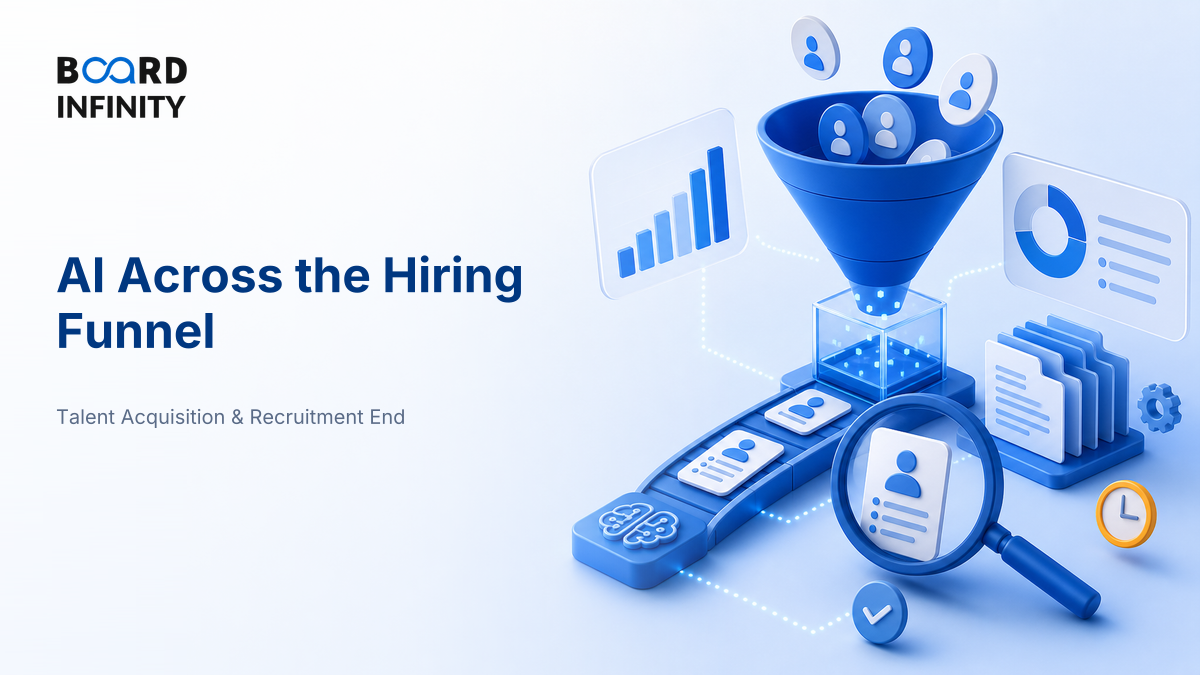
The hiring funnel has three high-volume stages where AI is most visible: sourcing, screening and matching. Each solves a different problem.
1. Sourcing: finding candidates before they apply
Sourcing means identifying and attracting potential candidates for a role. AI improves sourcing by scanning large talent pools, inferring skills from resumes and profiles, matching adjacent skills and recommending passive candidates.
For example, a company hiring for a data product role may not search only for “Product Manager - Analytics.” A good AI system may also surface candidates with product ownership, SQL, experimentation and stakeholder-management signals even if the exact title is different.
2. Screening: deciding who clears the minimum bar
Screening means filtering applicants against role-relevant criteria before deeper evaluation. AI can parse resumes, extract education and experience, detect missing must-have requirements and flag inconsistencies.
The key word is role-relevant. Screening should not become a black-box rejection engine. If the job requires advanced Excel and client communication, the model should screen for those signals - not proxy variables such as college brand, address or unexplained career gaps.
3. Matching: ranking candidate-job fit
Matching means estimating how well a candidate fits a role based on skills, experience, preferences and constraints. Modern matching engines often use a skills ontology - a structured map of related skills - to understand that “demand forecasting,” “time-series modelling” and “inventory planning analytics” may be connected.
Indian job platforms such as Naukri operate in a market with enormous application volumes, uneven resume formats and title inflation across industries. AI-based search and recommendation help recruiters move beyond exact keywords toward relevance-ranked profiles. The strategic so what: in high-volume Indian hiring, speed matters, but relevance and fairness decide whether speed creates value or just faster rejection.
The human-in-the-loop operating model
The strongest AI hiring systems do not remove recruiters. They change what recruiters spend time on: less manual resume scanning, more role calibration, shortlist quality, candidate engagement and bias checks.
Metrics to Track in an AI Hiring Funnel
If a candidate says “AI improves hiring efficiency” but cannot measure it, the answer feels shallow. Use these six metrics to sound practical.
In India, also discuss data protection. Candidate data is personal data, so employers should apply consent, purpose limitation, access control, retention limits and vendor governance consistent with the Digital Personal Data Protection Act, 2023.
Definitions You Must Get Right
- AI in hiring: Use of algorithms to support sourcing, screening, matching and recruitment decisions using candidate and job data.
- Sourcing: Identifying and attracting potential candidates before or during the application stage.
- Screening: Filtering applicants against job-relevant minimum criteria before deeper assessment.
- Matching: Ranking candidate-job fit using skills, experience, preferences and role requirements.
- Skills ontology: A structured map showing how skills, roles and capabilities relate to each other.
- Human-in-the-loop: A design where humans review, override or audit algorithmic recommendations before consequential decisions.
The safest language in an interview is “AI-assisted hiring,” not “AI decides hiring.” That one phrase signals maturity.
Naukri: AI Matching in a High-Volume Indian Talent Marketplace
Naukri shows why AI hiring is most valuable when huge candidate volume must be converted into relevant recruiter attention.

Situation: Indian recruiters often deal with very high application volume, varied resume formats and inconsistent job titles. A single role can attract candidates who use different titles for similar work, while some high-potential candidates may not use the exact keywords a recruiter searches for.
The move: Naukri and similar job platforms increasingly use AI-led search relevance, profile recommendations and resume parsing to help recruiters discover better-fit candidates faster. The primary driver is relevance ranking at scale. Supporting drivers include large candidate databases, structured profile data, recruiter behaviour signals, job-description parsing and feedback loops from recruiter actions.
Outcome or lesson: The lesson is not that AI “solves hiring.” The lesson is that AI can make a large talent marketplace more usable by reducing manual search effort and improving candidate discovery. But the quality of the output still depends on updated profiles, clear job descriptions, bias checks and recruiter review.
Interview takeaway: The best AI hiring systems win through a combination of scale, structured data, feedback loops and recruiter judgment - not through automation alone.
How AI Changes Sourcing, Screening & Matching
AI is no longer just a resume parser bolted onto an applicant tracking system. In 2026, three shifts matter most.
Practical student workflow: Use ChatGPT or Claude to prepare for a company-specific answer. Paste a job description, ask the tool to extract must-have skills, nice-to-have skills and possible bias-prone screening proxies, then build a “human-in-the-loop” hiring funnel for that role. Cross-check with Perplexity for recent HR-tech and regulatory developments before using it in an interview.
Never present AI hiring as purely technical. Candidate data privacy, explainability, audit trails and adverse impact checks are part of the operating model.
Interview Relevance
“A company receives thousands of applications for entry-level sales roles. How would you use AI across sourcing, screening and matching, and what risks would you control?”
Use the phrase “AI should improve recruiter judgment, not hide it.” It captures efficiency and ethics in one sentence.
Common Mistake
The biggest mistake is saying “AI removes bias from hiring.” It can reduce some human inconsistency, but it can also learn bias from historical data, proxies and poor job criteria. One-line fix: say “AI must be audited for job relevance, adverse impact and explainability before it is trusted.”
What to Revise Next
Now move one step deeper into the hiring process. First revise AI in Interviewing & Assessment: Claims versus Evidence to separate valid assessment signals from HR-tech hype. Then revise Case Study: Fixing a Broken Hiring Funnel to practise applying the full funnel to a messy business problem.