
How Finance Connects with Strategy, Operations, Marketing & Product
A ₹199 price tag in a value-fashion store looks like marketing. It is actually a chain of finance choices - fabric economics, store productivity, inventory risk, supplier terms and cash recovery - compressed into one tiny label.
- Finance connects the business by translating choices into value, cash and risk.
- Strategy asks, “Where should we play?” Finance asks, “Will this choice earn more than the capital it consumes?”
- Operations asks, “How do we deliver?” Finance tracks unit cost, working capital, capacity use and cash conversion.
- Marketing asks, “How do we grow demand?” Finance checks CAC, payback, margin, retention and profitable growth.
- Product asks, “What should we build?” Finance tests unit economics, pricing, adoption, lifetime value and portfolio bets.
- The best interview answer uses a value-driver tree: revenue growth, margin, capital efficiency and risk.
- Common trap: treating finance as accounting after the decision, instead of the logic inside the decision.
Big Picture: Finance Is the Translation Layer
Every function speaks a different language. Strategy speaks positioning, operations speaks throughput, marketing speaks demand, and product speaks customer value. Finance connects them by asking one disciplined question: what happens to enterprise value, cash flow and risk if we choose this option?
Core Explanation: How Finance Connects the Four Functions
The cleanest way to understand finance is not as “numbers after the fact,” but as a decision system. It forces each function to answer three questions:
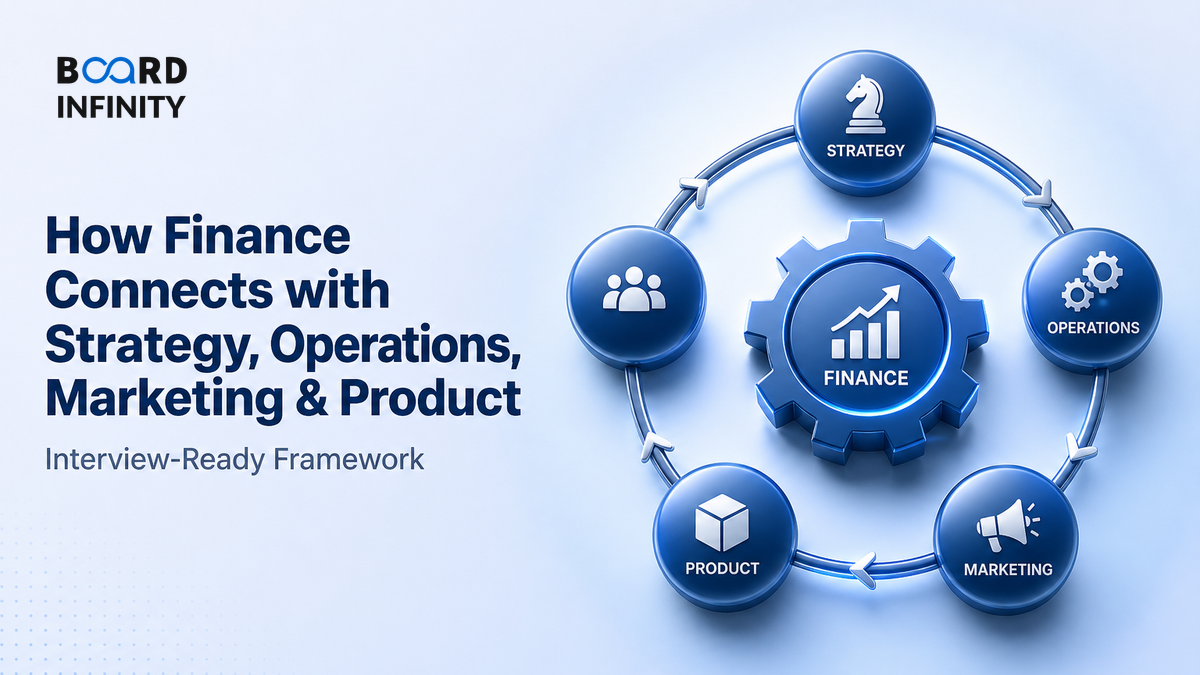
The Finance Bridge Across Strategy, Operations, Marketing and Product
Think of finance as the hub. The functions bring assumptions; finance tests whether those assumptions create economic value.
1. Finance and Strategy: From Ambition to Capital Allocation
Strategy chooses the arena and the advantage. Finance tests whether that arena deserves capital.
For example, a company may want to enter premium D2C skincare. The strategic logic may be strong - rising disposable income, brand-building potential, and repeat purchases. Finance adds discipline: expected gross margin, working-capital need, customer acquisition cost, break-even volume, and whether the return beats the company’s cost of capital.
Reliance Retail’s expansion across grocery, fashion, electronics and digital commerce is not only a scale strategy. It also depends on capital allocation across formats, store economics, supply-chain investment, private-label margins and customer traffic. The strategic so what: growth is valuable only when the operating model can convert scale into cash and defensible returns.
2. Finance and Operations: From Process Efficiency to Cash Flow
Operations decisions directly hit the income statement, balance sheet and cash-flow statement. Better procurement may lift gross margin. Faster inventory movement reduces working capital. Higher capacity utilization spreads fixed cost over more units. Poor quality, on the other hand, creates returns, rework, warranty cost and reputational risk.
The interview-ready line: operations creates the physical reality; finance measures whether that reality is economically efficient.
3. Finance and Marketing: From Growth to Profitable Growth
Marketing can create demand, but finance checks whether the demand is profitable. A campaign that brings high traffic but low conversion, heavy discounts and weak repeat purchase may destroy value. A smaller campaign with higher retention and better gross margin may be superior.
Good marketing-finance conversations do not ask, “Did the campaign go viral?” They ask, “Did the campaign acquire the right customers at the right cost with the right payback?”
4. Finance and Product: From Features to Unit Economics
Product teams decide what to build, how to price, and which customer problems to solve. Finance helps prioritize the roadmap by linking features to willingness to pay, adoption, retention, servicing cost and long-term margin.
In a SaaS product, a feature may look attractive because users ask for it. Finance asks whether it reduces churn, increases ARPU, improves conversion, or opens an enterprise segment large enough to justify engineering cost.
The Value-Driver Tree: The Framework That Makes It Click
When you are asked how finance connects with other functions, use this mental model: every business decision eventually moves one or more value drivers.
Metrics That Connect Finance to Business Decisions
These are the cross-functional metrics you should name in interviews. The “good” value is rarely universal; it depends on sector, business model and maturity. A good candidate says the formula and then compares it to peers, historical trend and the company’s cost of capital.
Worked Example: A Product Launch Decision in Finance Language
Suppose a company is launching a new personal-care SKU. The product and marketing teams like the concept. Finance converts the idea into unit economics.
Now the functional connection becomes clear. Marketing must estimate whether demand can reach 50,000 units at the planned spend. Operations must confirm whether production and fulfilment can support that volume without quality failures. Product must ensure repeat purchase and differentiation. Strategy must decide whether this SKU strengthens the portfolio or distracts capital from better bets.
Definitions You Can Say in One Breath
- Finance: Finance allocates capital, prices risk and manages cash to create enterprise value.
- Strategy - Michael Porter: “Strategy is the creation of a unique and valuable position, involving a different set of activities.”
- Operations: Operations converts inputs into goods and services through process design, capacity, quality and delivery choices.
- Marketing-finance link: Marketing creates demand; finance checks whether that demand is profitable, repeatable and cash-generative.
- Product-finance link: Product finance connects customer value, unit economics and investment choices across a product life cycle.
Case Study: Trent’s Zudio - Finance Hidden Inside a Value-Fashion Strategy
Zudio shows how a value-fashion concept can connect strategy, product, operations, marketing and finance into one coherent economic model.

Situation: Indian apparel retail has a large value-conscious customer base. The opportunity is attractive, but the economics are unforgiving: fashion risk, rent, inventory obsolescence, discounting and supply-chain complexity can quickly destroy margin.
The move: Trent built Zudio around a sharp value-fashion proposition: affordable, trend-responsive apparel with a simplified store experience. The primary driver is the fit between price architecture and operating model. Supporting drivers include private-label control, disciplined assortment, frequent refreshes, store productivity, inventory rotation, and a marketing model that relies more on store presence and word-of-mouth than heavy celebrity-led advertising.
The finance connection: Zudio’s strategy is not just “sell cheap clothes.” Finance shows why the model must work as a system: low price requires tight sourcing and product design; fast-changing fashion requires inventory discipline; store expansion requires capital productivity; limited advertising intensity requires strong footfall and repeat visits.
Outcome or lesson: The memorable lesson is that finance is not a separate department approving bills. In a strong business model, finance is embedded in the proposition itself: what you sell, how you source, how fast inventory moves, how stores earn back capital, and how growth is funded.
How AI Changes Finance as a Business Connector
AI makes finance business partnering faster, more granular and more forward-looking. The important shift is from reporting “what happened” to simulating “what could happen if we change price, spend, capacity or product mix.”
Student workflow: Before a finance or strategy interview, load a company’s annual report, investor presentation and this lesson into NotebookLM. Ask: “Create a value-driver tree for this company and identify how strategy, operations, marketing and product decisions affect revenue growth, margins, working capital and risk.” Then use ChatGPT or Claude to convert that into a two-minute interview answer.
Interview Relevance
“Finance is often called the language of business. Explain how finance connects with strategy, operations, marketing and product decisions. Give an example.”
If you want to sound senior, say: “Finance is not a veto function; it is a trade-off function. It helps the business choose between growth, margin, cash speed and risk.”
Common Mistake
The biggest mistake is saying finance “supports” other functions only through budgeting and reporting. That sounds junior because it puts finance after the decision. Fix: start with a value-driver tree and show how finance shapes the decision before money is spent.
What to Revise Next
Now that you understand finance as the connector across business functions, revise the rules and roles that make finance trustworthy and actionable.