
Leave, Attendance & Working Hours Rules in India
At 8:55 a.m., a biometric gate at a garment factory starts deciding more than punctuality - it decides wages, overtime, weekly rest, leave balance and whether the employer can defend itself in an audit. The mistake many managers make is treating attendance as an HR admin issue; in India, it is a legal compliance system.
- Leave and working hours in India are not governed by one single rulebook - they depend on establishment type, state, employee category and applicable statute.
- Factories generally follow the Factories Act, 1948 until the relevant Labour Code provisions are brought into force; shops and offices usually follow state Shops and Establishments laws.
- For adult factory workers, the core cap is 48 hours per week and 9 hours per day, with overtime paid at twice the ordinary rate under the Factories Act.
- Leave is a statutory minimum plus company policy - employers may be more generous, but cannot go below the applicable legal floor.
- Attendance data drives payroll, overtime, leave deduction and disciplinary action, so records must be accurate, auditable and privacy-conscious.
- The future framework is the Four Labour Codes, especially the Occupational Safety, Health and Working Conditions Code, but full implementation depends on notification and rules.
- Best interview answer: identify the law, classify the workforce, apply hour and leave rules, build records, then audit exceptions.
Big Picture: First Find the Law, Then Apply the Policy
The key mental model is simple: company policy comes last, not first. You begin with where the establishment operates, what type of establishment it is, who the worker is, and which statute applies. Only then do you design leave, attendance and working-hour rules.
Core Explanation: The Three Parts of HR Time Compliance
Think of this topic as a triangle: leave entitlement, attendance evidence and working-hour limits. If any one side is weak, payroll and compliance become vulnerable.
1. Which Law Applies?
India has a layered labour-law structure. A corporate office in Gurugram, a retail store in Bengaluru and a manufacturing plant in Tamil Nadu may all belong to the same company, but their leave and working-hour rules may be governed differently.
Interview-safe caveat: The four Labour Codes have been passed, but full practical implementation depends on central and state notifications and rules. Until then, existing applicable laws continue to matter.
2. Leave Rules: The Legal Minimum Plus Company Policy
Leave is not merely a benefit. It is partly a statutory right and partly an employer-designed policy. The correct HR answer separates both.
For adult factory workers, the Factories Act provides annual leave with wages after the qualifying service condition is met. For shops and offices, the exact number of earned leave, casual leave and sick leave days can vary by state, so a national HR policy must either state-wise map entitlements or offer a higher uniform benefit that meets every state minimum.
3. Working Hours: Normal Hours, Breaks, Weekly Off and Overtime
Working-hour rules answer four questions: How long can the employee work in a day? How long in a week? When must the employee receive rest? What happens if the employee works beyond the cap?
Many state Shops and Establishments laws also use similar working-hour logic for offices, shops, malls, restaurants and service businesses, but the exact rule must be checked state by state.
4. Attendance Rules: Evidence, Not Just Presence
Attendance is the evidence layer behind wages, overtime, leave and discipline. A clean attendance system should answer: who worked, when they worked, where they worked if relevant, whether overtime was approved, and how exceptions were regularised.
Biometric machines, swipe cards, mobile apps and manual muster rolls can all support attendance, but the principle is the same: the record must be accurate, accessible, tamper-resistant and aligned with the statutory registers required for that establishment.
5. What HR Should Track: Compliance Metrics That Actually Matter
Good HR teams do not wait for a labour inspection or payroll dispute. They monitor exception patterns every month.
Definitions: Say These Cleanly
Factories Act, 1948 - weekly hours: “No adult worker shall be required or allowed to work in a factory for more than forty-eight hours in any week.”
Factories Act, 1948 - daily hours: “No adult worker shall be required or allowed to work in a factory for more than nine hours in any day.”
Factories Act, 1948 - overtime principle: Work beyond prescribed daily or weekly hours attracts wages at twice the ordinary rate.
HR definition - attendance: Attendance is the recorded evidence of an employee's presence, absence, work time and exceptions for payroll and compliance.
Case Study: Shahi Exports and the Discipline of Auditable Working-Time Compliance
Shahi Exports shows why large-scale Indian manufacturing needs working-time systems that satisfy both Indian labour law and global buyer compliance expectations.
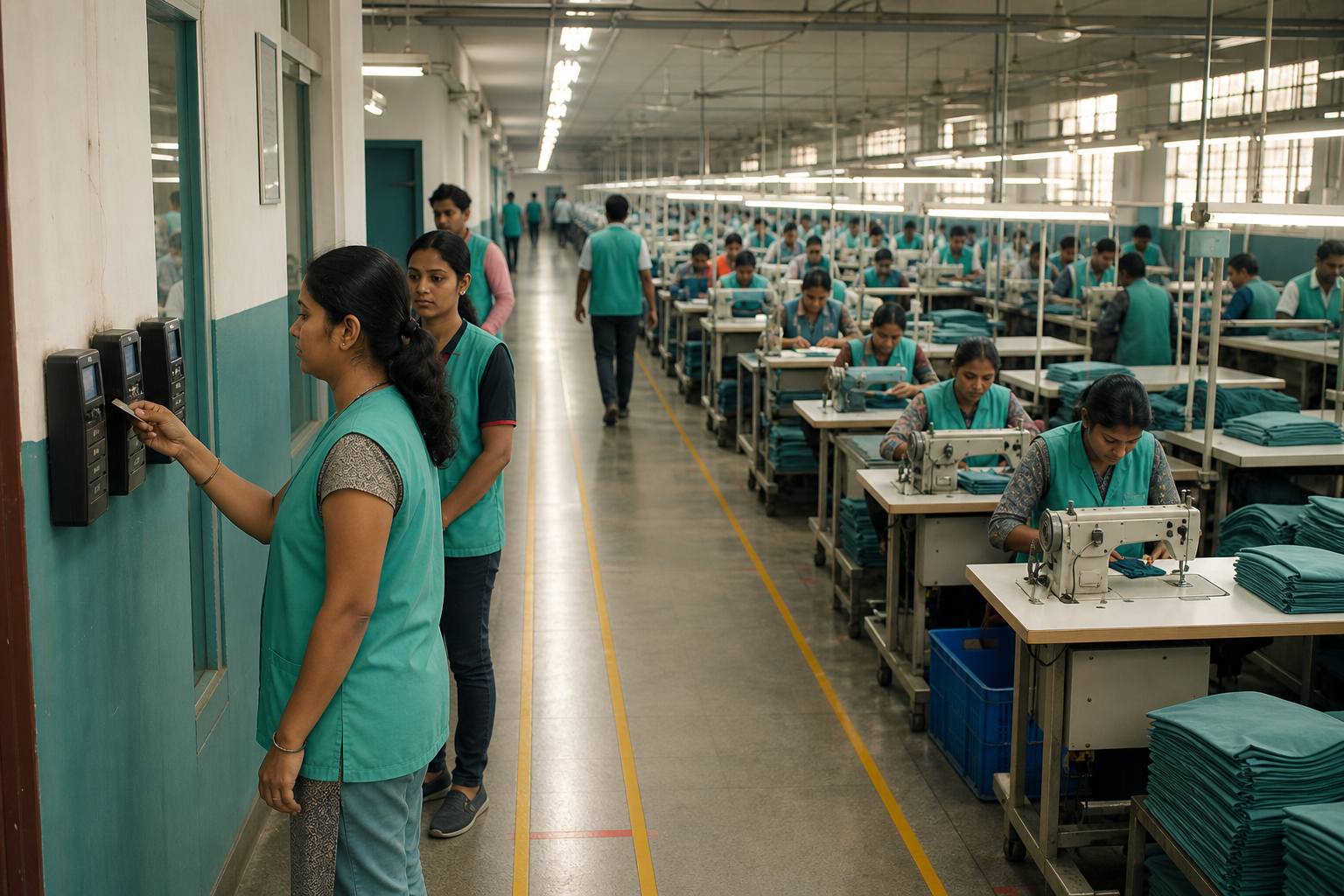
Situation: Shahi Exports, one of India's major apparel exporters, operates in a sector where order deadlines, seasonal peaks and buyer audits create intense pressure on factory scheduling. In apparel manufacturing, a small attendance or overtime gap can become a wage issue, a statutory issue and a customer audit issue at the same time.
The move: The company's working-time discipline depends chiefly on auditable factory-level HR systems - shift records, leave tracking, overtime approvals and worker-facing processes. This primary driver is supported by supervisory training, buyer code-of-conduct requirements, internal compliance reviews and worker communication mechanisms.
The lesson: The strategic value is not merely “following the law.” It is operational trust. When attendance, overtime and leave records reconcile, the company can plan capacity, pay workers correctly, respond to audits and protect buyer relationships.
How AI Changes Leave, Attendance & Working Hours Rules in India
AI does not change the legal entitlement. It changes how quickly HR can detect risk, plan rosters and explain exceptions.
Use NotebookLM or Perplexity to upload a company's employee handbook, relevant state Shops and Establishments rules and annual report extracts. Ask: “Create a state-wise risk checklist for leave, attendance, overtime and weekly-off compliance for this company.” Then verify every legal claim against the statute or official rule.
Interview Relevance
“You are joining as HR manager for a retail chain expanding from Mumbai to Bengaluru and Chennai. How will you design its leave, attendance and working-hours policy?”
Use this line in interviews: “I would not begin by copying one HR policy across India; I would first create a state-wise compliance matrix and then design the employee experience on top of it.”
Common Mistake
The mistake: Giving one universal answer like “India has 9 hours per day, 48 hours per week and 21 days leave” for every employee. Why it costs marks: it ignores state Shops and Establishments laws, establishment type and category-specific protections. One-line fix: always start with “Which state, which establishment, which worker category, which applicable statute?”