
Organisation Structures: Functional, Divisional & Matrix
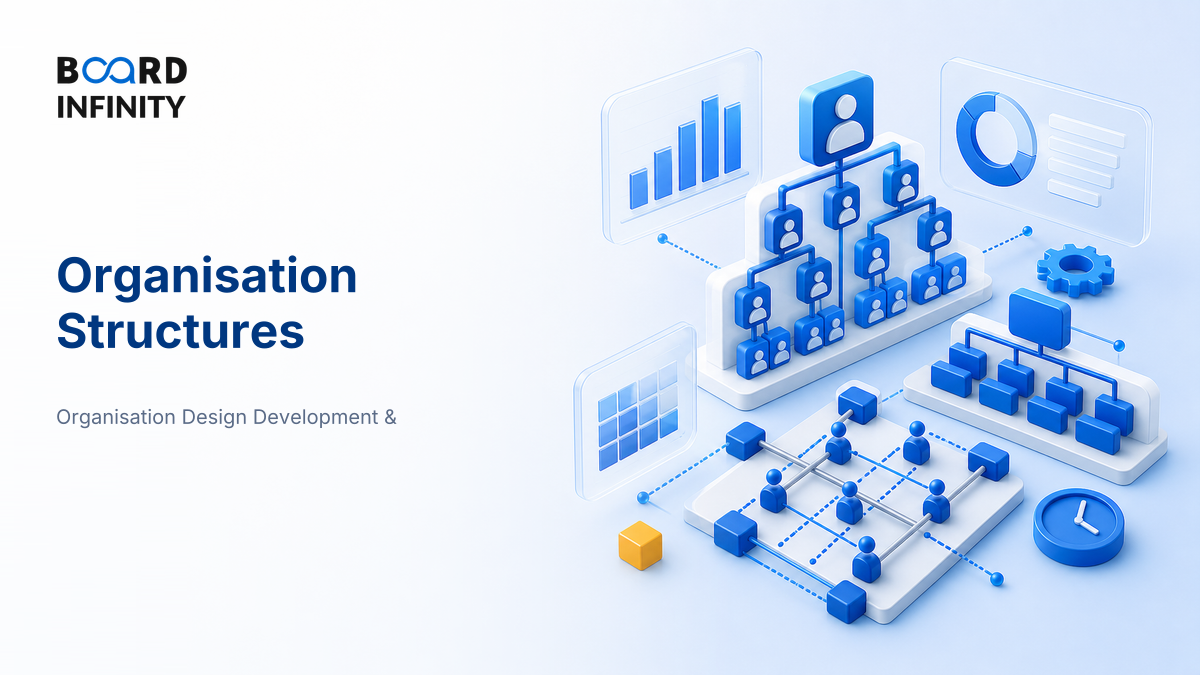
A customer in a Titan jewellery store asks for a design she saw online, the store manager checks regional inventory, merchandising checks demand, the design team reads the trend, and supply chain decides whether to replenish. That simple request travels through an organisation structure - invisible to the customer, but painfully visible to employees when it is badly designed.
- Organisation structure decides how work is divided, who reports to whom, and how coordination happens.
- Functional structure groups people by expertise - marketing, finance, operations, HR, technology.
- Divisional structure groups people by product, geography, customer segment or business unit.
- Matrix structure creates dual reporting - usually to a function and to a product, project or geography.
- Functional is best for efficiency and expertise; divisional is best for market focus and accountability; matrix is best when both expertise and market responsiveness matter.
- The trade-off is simple: every structure solves one coordination problem while creating another.
- In interviews, do not just define structures - recommend one based on strategy, scale, complexity and decision speed.
Big Picture: Structure Follows the Coordination Problem
Do not memorise functional, divisional and matrix as three static boxes. Think of them as three answers to one question: what must this company coordinate most carefully to win? If expertise is the bottleneck, go functional. If market accountability is the bottleneck, go divisional. If both matter at once, consider matrix.
Core Explanation: The Three Structures You Must Know
An organisation structure is the formal arrangement of roles, reporting lines, responsibilities and coordination mechanisms. It answers four practical questions:
1. Functional Structure: Built Around Expertise
In a functional structure, employees are grouped by specialised function - marketing, finance, sales, operations, technology, HR and so on. A marketing analyst reports into marketing, a plant engineer reports into operations, and a recruiter reports into HR.
This structure works beautifully when the organisation has a focused product line, wants deep expertise, and needs efficiency through standardisation. It becomes painful when customers, geographies or product lines become very different from each other.
Apple is widely known for its strong functional orientation, where deep expertise in design, hardware, software, operations and marketing is coordinated at senior levels. The primary driver is integration around product excellence, supported by a focused portfolio, strong leadership reviews and a culture of specialist depth. The strategic so what: functional structures can support innovation when coordination is disciplined, not left to informal goodwill.
2. Divisional Structure: Built Around Markets or Businesses
In a divisional structure, the company is grouped around products, geographies, customer segments or business units. Each division may have its own sales, marketing, operations and finance teams, often with profit-and-loss accountability.
This structure is useful when a company has multiple product categories, operates across regions, or serves very different customer groups. It increases accountability and speed near the market, but it can duplicate resources and create silos.
3. Matrix Structure: Built Around Dual Priorities
A matrix structure combines two dimensions of reporting. An employee may report to a functional head for capability and standards, and to a project, product, geography or business leader for delivery priorities.
Matrix structures are common in consulting firms, IT services, global consumer companies, pharma, engineering and product-led organisations where expertise and market responsiveness both matter. The benefit is cross-functional coordination. The cost is ambiguity, meetings and power conflict if decision rights are unclear.
Functional vs Divisional vs Matrix: The Fast Comparison
How to Choose the Right Structure
A strong answer does not say one structure is “best.” It says, “Given the company’s strategy and complexity, this structure creates the fewest coordination costs.” Use this decision logic:
Types of Matrix Structure
Matrix is not one design. It varies by how much power sits with the function versus the project or business side.
How to Test Whether a Structure Is Working
Organisation structures fail quietly before they fail visibly. Watch for slow decisions, duplicated work, escalations, unclear ownership and frustrated managers. These measures help diagnose structure health:
Definitions
Henry Mintzberg defined organisational structure as “the sum total of the ways in which its labor is divided into distinct tasks and then its coordination is achieved among these tasks.”
Functional structure: An organisation design that groups employees by specialised functions such as marketing, finance, operations, HR or technology.
Divisional structure: An organisation design that groups employees by product, geography, customer segment or business unit.
Matrix structure: An organisation design where employees report across two dimensions, commonly function and product, project or geography.
Titan Company: From Watchmaker to Multi-Category Lifestyle Organisation
Titan shows why growing companies often move beyond pure functional structures into divisional businesses supported by shared capabilities.

Situation: Titan began with a strong identity in watches and later expanded into jewellery, eyewear, wearables and other lifestyle categories. Each category had different economics, customer behaviour, retail experience, inventory risk and brand-building needs. A pure functional structure would have made it hard to give each business the attention it deserved.
The move: Titan operates through business divisions such as jewellery, watches and wearables, eyewear and emerging businesses, while still relying on shared strengths like retail discipline, design capability, supply chain, finance, technology and brand governance. The primary driver is category-specific accountability. Supporting drivers include retail execution, trusted brand architecture, design capability and disciplined operations.
The lesson: Divisional structure helps a diversified company stay close to each category’s market realities, but shared capabilities prevent every division from reinventing the wheel.
How AI Changes Organisation Structures
AI is not just another tool inside the old chart. It changes what work needs human coordination and where expertise sits.
- Lean functional teams become more powerful. Marketing, finance, HR and analytics teams can use AI copilots for research, drafting, reporting and analysis, reducing some routine coordination load.
- Matrix work becomes easier to coordinate. AI-enabled project dashboards, meeting summaries and knowledge bases help cross-functional teams track decisions, owners and dependencies.
- Skills-based structures become more realistic. Instead of staffing only by fixed departments, companies can map skills, projects and capacity more dynamically. The caveat: employee data must be handled with privacy, fairness and transparency.
Use NotebookLM or ChatGPT before an interview: upload the company annual report, leadership page and business segment notes, then ask, “Infer whether this company is functional, divisional or matrix. What evidence supports the answer, and what structure risks should I mention?”
Interview Relevance
“Compare functional, divisional and matrix structures. If an Indian D2C brand is expanding into offline retail and international markets, which structure would you recommend?”
Use the phrase: “The right structure is the one that reduces the most expensive coordination problem.” It makes your answer sound managerial, not textbook.
Common Mistake
The biggest mistake is drawing boxes without explaining trade-offs. It costs candidates because structure questions test judgement, not memory. One-line fix: always link the structure to strategy, decision speed, accountability and coordination cost.