
Rating Scales, Forced Distribution & the Calibration Meeting
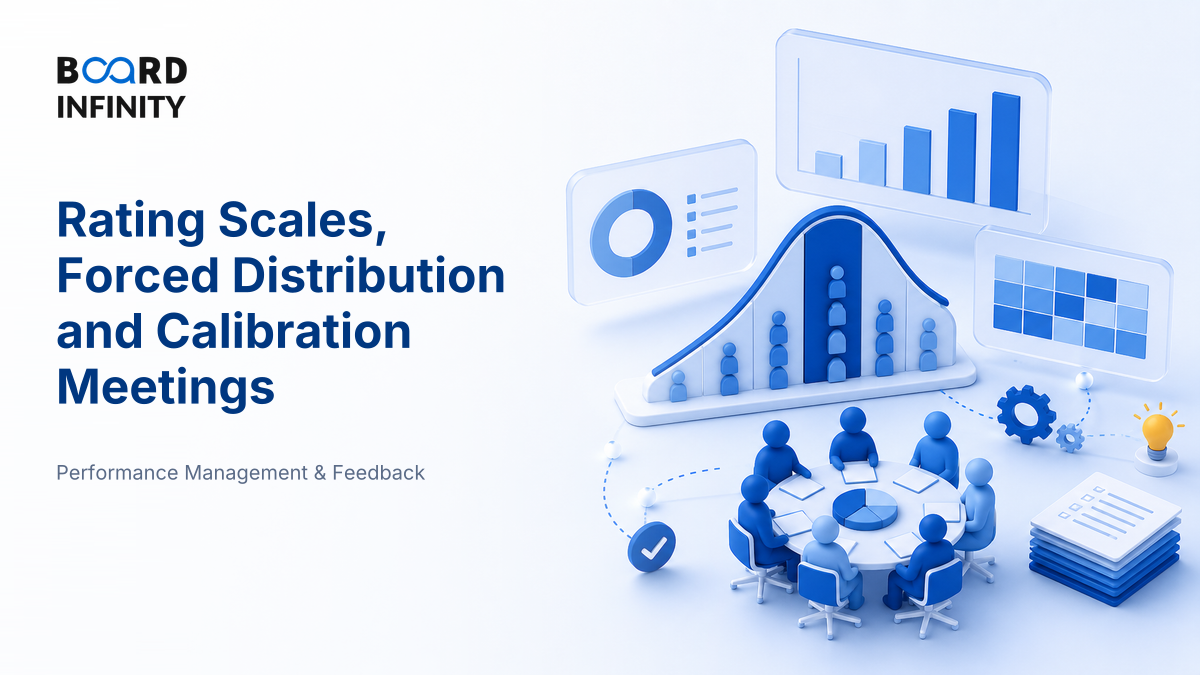
The biggest myth about performance ratings is that a number makes judgment objective. In one review room, two managers can see the same employee evidence and still disagree: one says “Exceeds,” another says “Meets,” and a third wants to protect their team’s bonus pool.
- Rating scales convert performance evidence into defined levels such as 1-5, Meets/Exceeds, or Below/At/Above expectations.
- Forced distribution is a relative-rating method that requires a fixed percentage of employees in each performance category.
- Calibration meetings align managers on rating standards before final ratings, pay, promotion or performance actions are confirmed.
- A good rating system separates results from behaviours, uses clear anchors, and is backed by evidence.
- Forced distribution improves differentiation but can damage collaboration if used mechanically as a quota.
- Calibration is not “rating politics”; done well, it reduces leniency, harshness and team-to-team inconsistency.
- The best interview answer compares all three: scale = language, forced distribution = allocation rule, calibration = fairness process.
Big Picture: The Performance Rating System Is a Loop, Not a Form
Think of performance management as a cycle of evidence, judgment, alignment and consequences. Rating scales, forced distribution and calibration meetings sit at different points in that loop.
Core Explanation: Three Tools, Three Different Jobs
The confusion starts because all three terms appear during annual reviews. But they answer different questions.
Rating Scales: The Common Language of Performance
A rating scale translates performance evidence into a small number of categories. The scale may be numeric, descriptive, behaviourally anchored, or outcome-based.
Gary Dessler defines performance appraisal as “evaluating an employee’s current and/or past performance relative to his or her performance standards.”
A strong scale has three design choices:
Weak scale language sounds like “good attitude” or “needs improvement.” Strong scale language says “delivered agreed milestones with minimal rework” or “missed agreed service standards despite coaching.”
Forced Distribution: Differentiation by Design
Forced distribution is a performance-rating method where a fixed proportion of employees must be assigned to each category. It is also called forced ranking, stack ranking, or a bell-curve system, depending on design.
The logic is simple: if every manager rates most people highly, performance pay and promotion decisions lose credibility. Forced distribution tries to prevent grade inflation by requiring visible differentiation.
But the danger is equally clear. If a team is genuinely strong, the system still pushes someone into a lower bucket. If a team is genuinely weak, someone may still be pushed upward. That is why forced distribution must be used with comparable roles, sufficient population size and transparent evidence.
Worked Example: How a Forced Distribution Works
Assume a company is reviewing 100 comparable sales executives. The target distribution is 20 percent high performers, 70 percent solid performers and 10 percent low performers.
The calculation is not difficult. The managerial challenge is whether the 20, 70 and 10 labels are defensible using evidence, not just a spreadsheet quota.
Calibration Meeting: Where Ratings Are Stress-Tested
A calibration meeting is a structured discussion where leaders compare proposed ratings across teams to ensure similar performance receives similar ratings.
It usually happens after managers submit draft ratings and before final communication to employees. HR facilitates the process, but business leaders must own the evidence.
What Actually Happens in a Calibration Room
How to Evaluate Whether the System Is Working
Do not evaluate a rating system only by whether leaders “feel comfortable.” Track whether ratings are reliable, differentiated and connected to business outcomes.
Definitions You Can Say in One Breath
A rating scale is a standardized set of levels used to classify employee performance against defined expectations.
Forced distribution assigns employees to performance categories according to a predetermined percentage spread.
A calibration meeting aligns managers on rating standards by comparing evidence across employees before final decisions.
Indian Example: Infosys and the Bell-Curve Pressure
Indian IT services firms, including Infosys, have historically been associated with bell-curve style performance differentiation because large workforces require structured appraisal, pay and promotion decisions. As digital work became more project-based, collaborative and skill-intensive, strict forced ranking became harder to defend as the only lens.
The strategic lesson is not “bell curves are bad.” The lesson is sharper: in large Indian organizations, relative differentiation may help manage scale, but it must be supported by clear goals, manager training, skill evidence and fair calibration. Otherwise employees see the process as quota management rather than performance management.
Case Study: Microsoft Moved Away from Stack Ranking
Microsoft ended its stack-ranking approach to reduce internal competition and support more collaborative performance management.

Situation: Microsoft was widely reported to have used a stack-ranking system in which employees were compared against one another and placed into performance categories. Over time, critics argued that this encouraged internal competition, risk avoidance and protection of individual ratings.
The move: Microsoft moved away from stack ranking and toward a performance approach that placed more emphasis on collaboration, impact and ongoing manager-employee conversations. The primary driver was cultural: a company trying to innovate across cloud, software, hardware and enterprise services needed teams to share knowledge rather than optimize only for individual ranking. Supporting drivers included leadership change, the need for faster cross-functional execution and a broader shift in technology firms toward continuous feedback.
Outcome and lesson: The lesson for HR is not that all ratings should disappear. It is that the rating architecture must match the business strategy. A highly interdependent innovation business needs performance systems that reward both individual contribution and collaborative impact.
How AI Changes Rating Scales, Forced Distribution & the Calibration Meeting
AI does not remove managerial judgment. It changes the evidence base and the quality checks around that judgment.
- AI can summarize performance evidence. Tools can pull themes from goals, project updates, customer feedback, OKR notes and manager check-ins. This reduces recency bias, where managers overweigh the last few weeks.
- AI can flag rating-pattern risk. HR analytics teams can detect lenient managers, harsh managers, gender or location skews, and unexplained rating compression before calibration.
- AI can support calibration preparation. LLMs can help managers draft evidence-based rating rationales, but HR must prevent hallucinated evidence and biased language.
Use ChatGPT or Claude to create a calibration prep sheet: paste a fictional employee’s goals, results and behaviours, then ask for a rating recommendation, evidence gaps and likely calibration challenges. Then critique the output for bias and missing context.
Interview Relevance
“How would you design a fair performance appraisal system for a 5,000-employee company? Would you use forced distribution?”
If asked whether forced distribution is good or bad, avoid a moral answer. Say: “It depends on workforce comparability, culture, evidence quality and how tightly the company links ratings to rewards.”
Common Mistake
The costly mistake is treating calibration as the same thing as forced distribution. Forced distribution imposes a percentage rule; calibration aligns standards through evidence. One-line fix: say “calibration can exist with or without forced distribution.”
What to Revise Next
Next, move from manager-only appraisal to multi-source and continuous performance systems. Revise Three-Hundred-and-Sixty-Degree Feedback Done Properly to understand broader feedback inputs, then study Continuous Feedback and Moving Beyond the Annual Review to see how modern companies reduce dependence on once-a-year ratings.