
Inclusive Policy Design: Leave, Benefits & Facilities
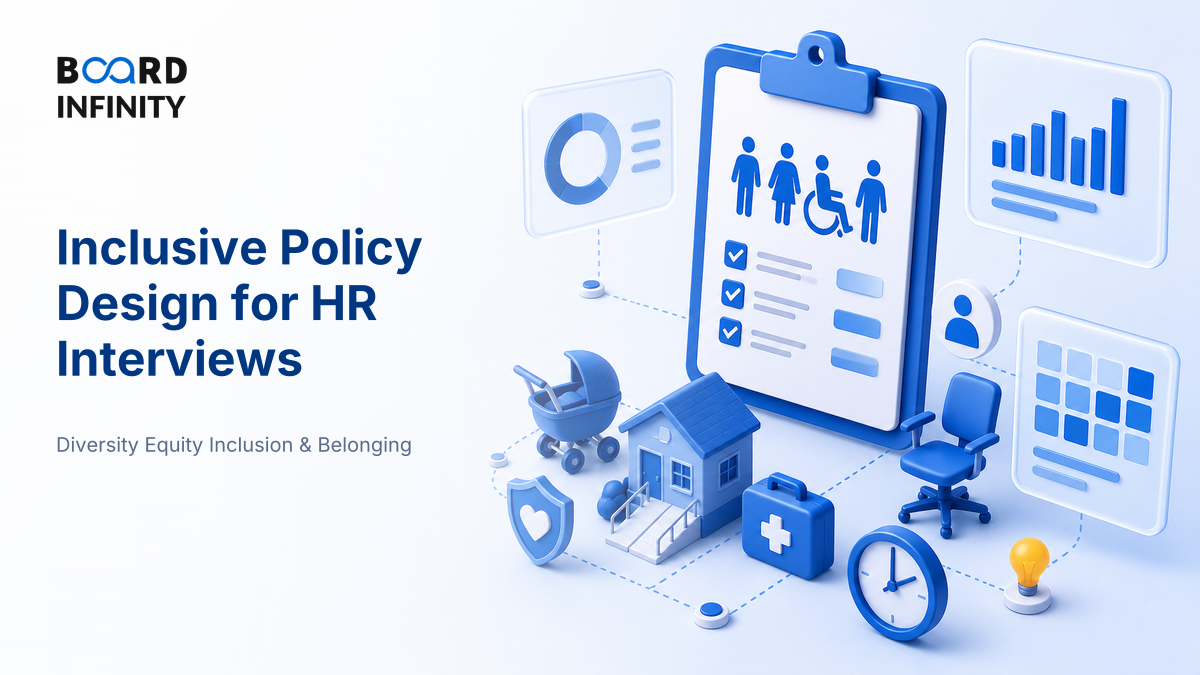
One employee returns from parental leave to a manager who says, “Take your time.” Another returns to an inbox full of missed deadlines, no pumping room, and a benefits portal that recognises only “husband” or “wife.” The policy may look equal on paper, but the lived experience is completely different.
- Inclusive policy design means building workplace rules so different life situations can access the same opportunity without stigma.
- Think in three layers: leave gives time, benefits give economic security, and facilities make daily work physically and psychologically usable.
- Equality gives everyone the same rule; equity adjusts access so people with different constraints can participate fairly.
- Good inclusive policies are clear on eligibility, language, privacy, manager discretion, grievance routes and measurement.
- India-specific anchors include the Maternity Benefit Act, Rights of Persons with Disabilities Act, Transgender Persons Act and POSH compliance.
- Measure inclusion through utilisation parity, return-to-work rate, retention after leave, accommodation closure time and accessibility compliance.
- The biggest trap is announcing progressive benefits without changing systems, facilities and manager behaviour.
Big Picture: Inclusion Lives in the Policy Stack
Inclusive policy design is HR architecture. A company is not inclusive because it has a DEI statement; it becomes inclusive when everyday policies remove predictable barriers for caregivers, women, LGBTQ+ employees, persons with disabilities, older workers, neurodivergent employees and employees with different family structures.
Core Explanation: The Three Design Questions
The simplest way to design an inclusive policy is to ask three questions: Who is excluded by the current rule? What life moment creates the barrier? What change makes participation possible without stigma?
1. Leave: Does the policy recognise real life events?
Leave is the employee’s right to time away from work without losing employment continuity. Inclusive leave goes beyond statutory minimums and recognises that employees may be parents, caregivers, patients, bereaved family members, adoptive parents, single parents, LGBTQ+ partners or employees undergoing gender transition.
Examples of inclusive leave categories include:
- Parental leave - maternity, paternity, adoption, surrogacy and gender-neutral caregiver leave.
- Caregiver leave - time to support children, elderly parents, disabled dependents or seriously ill family members.
- Medical and disability-related leave - recovery, treatment, mental health episodes or reasonable accommodation needs.
- Gender transition leave - time for medical, legal or social transition needs, where applicable.
- Bereavement and compassionate leave - designed without narrow definitions of family.
2. Benefits: Does the policy define family too narrowly?
Benefits are not just “perks.” They are risk protection. A benefit policy becomes exclusionary when it assumes that every employee has a legally married opposite-sex spouse, biological children, able-bodied dependents and a conventional household.
Gary Dessler describes benefits as indirect financial and nonfinancial payments employees receive for continuing employment with the company.
Inclusive benefits typically revisit medical insurance, dependent coverage, relocation support, fertility or adoption support, mental health access, domestic partner benefits, disability support and employee assistance programmes.
3. Facilities: Can people actually use the workplace?
Facilities convert inclusion from a policy PDF into a daily experience. A wheelchair-accessible entrance, lactation room, gender-neutral restroom, prayer or quiet room, safe transport, ergonomic workstation and assistive technology can decide whether an employee can work with dignity.
Inclusive Policy Design Framework
Use this four-step framework when asked to design or evaluate leave, benefits and facilities. It is sharp enough for an interview answer and practical enough for a real HR role.
What Good Inclusive Policies Contain
A strong answer should not stop at “give more leave.” The interviewer is testing whether you understand policy design as a system.
Metrics: How to Track Whether Inclusion Is Working
Inclusive policies must be measured without turning employees into labels. Use aggregated, consent-based and privacy-safe data. The goal is to spot barriers, not to profile individuals.
Definitions You Should Be Able to Say Clearly
- Inclusive policy design: Building workplace rules so different life situations can access the same opportunity without stigma.
- Equity: Fair access to opportunity by adjusting support for different starting points and constraints.
- Reasonable accommodation: The UN CRPD describes it as necessary and appropriate modification and adjustments not imposing a disproportionate or undue burden.
- Universal design: The UN CRPD defines it as design usable by all people, to the greatest extent possible.
Case Study: Tata Steel and LGBTQ+ Inclusive HR Policy
Tata Steel shows how inclusion can move from corporate intent to policy design in a traditionally male-dominated manufacturing context.

Situation: Steel manufacturing has historically been male-dominated, with demanding sites, shifts, safety rules and township-linked benefits. A conventional HR policy in such a context can easily assume a male employee, a heterosexual spouse, binary gender identity and traditional family structure.
The move: Tata Steel has publicly taken steps to make HR policies more inclusive for LGBTQ+ employees, including extending certain benefits to partners and recognising needs such as gender transition support. Reported policy elements include medical benefits for partners and special leave connected to gender reassignment. The important point is not one isolated benefit; it is the redesign of leave, benefits, language and workplace acceptance together.
Supporting drivers: The primary driver was policy recognition of identities and family structures that older HR systems often ignored. Supporting drivers included leadership signalling, HR process changes, employee communication, sensitisation and the practical challenge of making inclusion work in plants and operational roles, not only head offices.
Lesson: Tata Steel’s example is memorable because it shows that inclusion is not only a tech-office issue. Even in asset-heavy, safety-heavy industries, leave, benefits and facilities can be redesigned when leadership intent is translated into HR systems and line-manager practice.
How AI Changes Inclusive Policy Design
AI is changing inclusive policy design in three concrete ways, but it also creates new fairness risks.
- Policy gap scanning: LLMs can compare employee handbooks against legal requirements and inclusion benchmarks, flagging phrases like “wife,” “husband” or “maternity only” where broader language may be needed.
- Benefits personalisation: AI-enabled HR portals can help employees discover relevant benefits based on life events, but the system must avoid exposing sensitive identity, health or family information.
- Facility and accessibility analytics: Workplace data, service tickets and accommodation requests can reveal inaccessible locations, delayed approvals or recurring facility barriers across offices.
AI should support inclusion decisions, not silently decide eligibility. Sensitive data, disability status, gender identity and family structure need consent, minimisation, security and human review.
Student workflow: Load a company’s employee handbook, ESG or Business Responsibility report and relevant Indian legal notes into NotebookLM. Ask it to generate: “Which leave, benefits and facilities may exclude caregivers, LGBTQ+ employees, persons with disabilities or non-traditional families?” Then convert the output into a policy-gap table for interview practice.
Interview Relevance
“You are the HR manager of a 5,000-employee Indian company expanding to new cities. How would you design inclusive leave, benefits and facilities without making the policy financially reckless?”
Use the phrase “policy bundle”. It signals maturity because inclusive leave fails if benefits, facilities and manager behaviour do not change with it.
Common Mistake
The mistake: Candidates equate inclusion with adding one generous policy, usually maternity leave or work-from-home. Why it costs them: it ignores eligibility, stigma, facilities, manager discretion and measurement. One-line fix: map the employee life moment, redesign the full policy bundle and measure whether different groups can actually use it.