
Running an Experiment on an HR Intervention
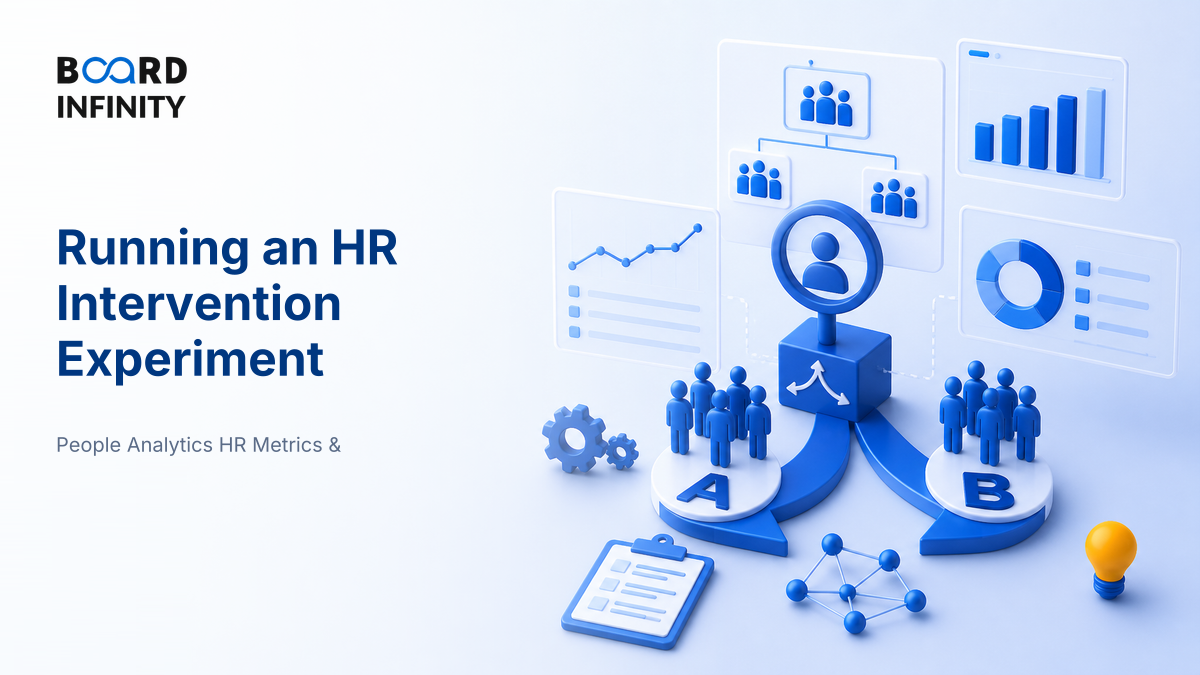
Two teams get the same new manager-training program. Three months later, one team’s attrition falls and the other team’s attrition does not - so did the training work, or did one team simply have a better manager, easier workload, or fewer resignations already in the pipeline?
- An HR experiment tests whether a deliberate people intervention caused a measurable outcome, not just whether things changed after it.
- The core question is counterfactual: what would have happened to the same employees if the intervention had not been given?
- The cleanest design is a randomized controlled trial: randomly assign eligible employees or units to treatment and control groups.
- Measure both HR outcomes and business outcomes - for example attrition, absenteeism, productivity, engagement and cost per retained employee.
- Before-after comparisons are weak because seasonality, manager quality, hiring mix or external shocks may explain the result.
- A good experiment defines the hypothesis, sample, intervention, control, metrics, time window, ethics and decision rule before launch.
- In interviews, do not say “run a survey and compare scores.” Say how you will establish causality.
Big Picture: An HR Experiment Is a Causality Machine
An HR experiment converts a people problem into a testable business question. Instead of asking “Did employees like the intervention?”, it asks: did this intervention cause a better outcome than the alternative?
Core Explanation: How to Run an Experiment on an HR Intervention
An HR intervention is a deliberate change in a people practice - such as onboarding, incentives, training, flexibility, coaching, recognition or performance feedback - intended to improve employee or business outcomes.
The experimental logic is simple: create two comparable groups, give the intervention to one group, withhold or use the current practice for the other, then compare outcomes after a defined time period. The difference is your estimated effect.
The Before-After Trap Versus a Real Experiment
Most weak HR analyses look persuasive because they show movement. Attrition fell after a new manager-connect program. Engagement rose after a wellness week. Productivity improved after training. But movement is not proof. A real experiment asks whether the change was greater than what would have happened anyway.
The Five-Step Process to Design the Experiment
Use this structure when you are asked how you would test any HR intervention - retention bonus, hybrid work, onboarding, learning program, referral scheme, wellness support or manager coaching.
Choosing the Right Experimental Design
Not every HR situation allows pure individual randomization. You may need to randomize by team, branch, store, cohort or region. The design choice depends on ethical sensitivity and operational feasibility.
Metrics: What to Track in an HR Intervention Experiment
A serious HR experiment tracks both employee outcomes and business outcomes. If you only track satisfaction, the business may not buy the recommendation. If you only track productivity, you may miss burnout, fairness or retention risk.
Worked Example: Testing a New Onboarding Buddy Program
Suppose a company wants to reduce 90-day attrition among new sales hires. It plans to test a buddy program in which each new hire receives a trained peer buddy for the first 12 weeks.
If 18 of 100 control hires exit within 90 days, the control attrition rate is 18%. If 11 of 100 treatment hires exit, the treatment attrition rate is 11%. The estimated reduction is 7 percentage points. A good HR answer then asks: is this difference statistically credible, practically valuable, and cost-effective after paying for buddy training and time?
Definitions You Should Be Able to Say in One Breath
- HR intervention: A deliberate change in a people practice intended to improve employee or business outcomes.
- Experiment: A test that manipulates an intervention and compares outcomes against a credible counterfactual.
- Randomized controlled trial: A study where eligible units are randomly assigned to treatment or control to estimate causal impact.
- Counterfactual: The outcome that would have occurred for the same unit without the intervention.
- Treatment effect: The difference in outcomes between the treated group and the comparable control group.
Case Study: Shahi Exports and Soft-Skills Training for Garment Workers
Shahi Exports, one of India’s large apparel manufacturers, became a powerful example of testing whether worker-focused soft-skills training can improve both employee and business outcomes.

Situation: Garment manufacturing is labour-intensive, deadline-driven and quality-sensitive. Traditional HR logic might treat life-skills training as a welfare activity - valuable, but hard to justify through business evidence.
The move: In research associated with the Personal Advancement and Career Enhancement programme, workers in Indian garment factories received structured soft-skills training while comparable workers did not receive it at the same time. The intervention focused on capabilities such as communication, problem-solving, time management and financial awareness. The important point for HR interviews is not just the training content - it is the design logic: compare treated workers with a credible control group and measure outcomes over time.
The outcome and lesson: Published research on this intervention reported positive effects on workplace outcomes and business value. The primary driver was not “training makes people happy.” The primary driver was skill application on the production floor - supported by improved confidence, communication, attendance behaviour and supervisor-worker interaction. The strategic lesson is sharp: when HR can show a causal link between capability building and productivity or retention, it moves from cost centre language to investment language.
Zomato publicly introduced period leave in India in 2020. It is a useful HR policy example, but not automatically an experiment unless the company defines comparison groups, outcome metrics and a time window. The strategic so what: a progressive policy can be valuable on ethical and employer-brand grounds, but causal claims require a stronger design.
How AI Changes Running an Experiment on an HR Intervention
AI does not remove the need for experimental design. It makes the design faster, the measurement richer and the risks more visible - if used carefully.
Practical student workflow: Use NotebookLM or Claude before an interview. Upload the company’s annual report, careers page and recent HR-related news. Ask: “Suggest three HR interventions this company could experimentally test, with treatment group, control group, metrics, ethical risks and a 90-day decision rule.” Then refine the answer using the five-step structure above.
Interview Relevance
“Suppose our company is facing high attrition among new hires. HR wants to launch a new onboarding intervention. How would you test whether it actually works?”
Use the phrase “credible counterfactual”. It signals that you understand causality, not just HR activity tracking.
Common Mistake
The single biggest mistake is treating a before-after improvement as proof that the HR intervention worked. It costs candidates because it ignores seasonality, manager quality, selection bias and external shocks. One-line fix: always compare the intervention group with a credible control or matched comparison group.